The Quantum Computing Breakthrough We've Been Waiting For
Atom Computing’s newly published paper may end up being remembered as one of the most important quantum computing milestones in years

AI is reshaping software, services, and knowledge work at extraordinary speed.
But there is an important limit to what AI alone can do.
No matter how intelligent an AI model becomes, it still runs on classical computing infrastructure. It can optimize, approximate, compress, and reason over problems, but it remains bounded by the computational constraints of classical architectures.
There are entire categories of economically important problems where the bottleneck is not intelligence, but computation itself:
molecular simulation
catalyst discovery
materials science
cryptography
large-scale optimization
physical system modeling
advanced semiconductor design
These problems sit underneath trillion-dollar industries:
pharmaceuticals
energy
manufacturing
logistics
defense
semiconductors
This is where quantum computing matters.
Not because it replaces AI.
Because it expands the frontier of computable problems that AI and classical systems can eventually operate on top of.
The strategic importance of quantum computing has therefore always been clear. The challenge has been that the industry has remained stuck between scientific promise and commercially viable infrastructure.
That is why Atom Computing’s newly published paper may end up being remembered as one of the most important quantum computing milestones in years.
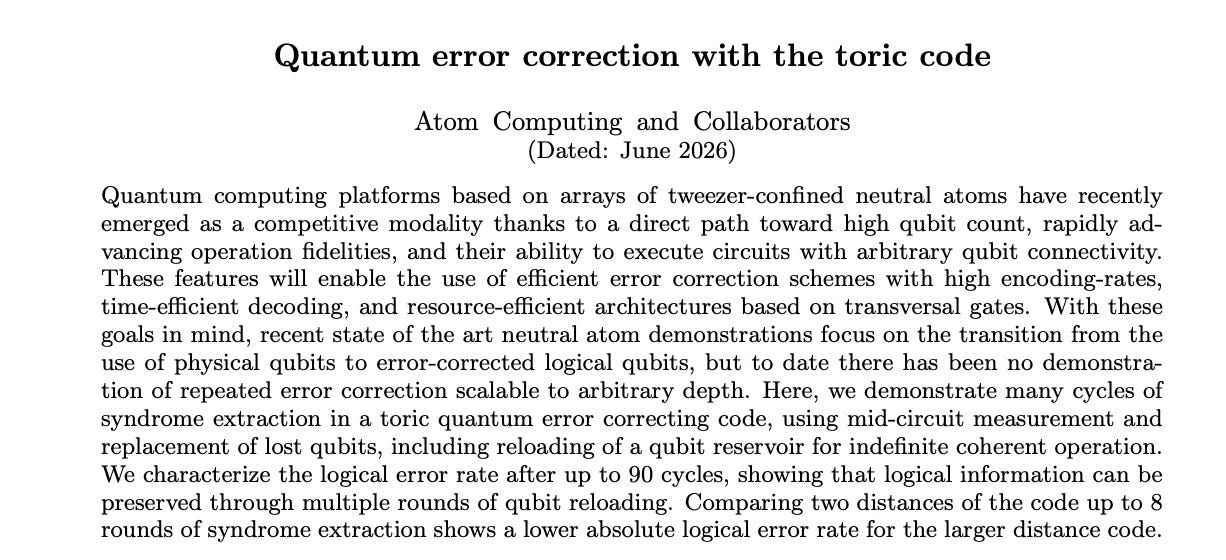
The real bottleneck in quantum computing
Most people still evaluate quantum computing companies through the wrong lens.
The conversation tends to revolve around:
qubit counts
fidelity percentages
benchmark demonstrations
Those metrics matter, but they are no longer the central challenge.
The real bottleneck is whether a quantum system can operate continuously while managing:
error correction
qubit degradation
qubit loss
system orchestration
operational scaling
In other words:
can a quantum computer function like infrastructure rather than a laboratory experiment?
This is much harder than it sounds.
Quantum systems are extraordinarily fragile. Operations introduce errors. Measurements disturb the system. Components degrade while computation is happening. The qubits literally disappear during computation.
This is where most architectures begin to break down.
To become commercially viable, quantum computing platforms ultimately need to demonstrate several things simultaneously:
the ability to continuously detect and fix errors
systems that can keep running reliably during long computations
protection against failures and instability
the ability to scale to much larger systems over time
continuous operation without constant resets or interruptions
resilience when individual components fail or degrade
flexible system designs that can adapt as the technology evolves
Very few systems have demonstrated even subsets of these capabilities together.
Atom Computing just demonstrated many of them simultaneously.
The Quantum Computing Breakthrough the Industry Has Been Waiting For — Five Major Advances
Today the Atom Computing team announced what I believe is one of the most important milestones the quantum computing industry has seen in years: the first complete demonstration of continuously operating quantum error correction in a neutral atom system.
With this result, Atom becomes one of two companies to demonstrate many rounds of performant quantum error correction, and the first neutral atom company to do so. The only other company to publicly demonstrate comparable sub-threshold error correction behavior to date has been Google using superconducting qubits.
Importantly, Atom demonstrated something even more significant than isolated logical operations.
The company showed that as the system became larger and more redundant, logical error rates improved rather than degraded.
In plain English:
the system became more reliable as it scaled.
Historically, this has been one of the defining bottlenecks in quantum computing. Larger systems often introduced so much additional noise, coordination overhead, and instability that performance worsened instead of improving.
Atom demonstrated the opposite while simultaneously showing continuous qubit replenishment, sustained operation, arbitrary qubit connectivity, and logical memory persisting beyond the lifetime of the underlying physical qubits themselves.
That combination is what makes this paper such an important breakthrough for the broader industry.
To double click into the major advancements demonstrated in the paper:
1. Repeated Quantum Error Correction During Live Computation
Atom demonstrated repeated error correction cycles using a toric code architecture with true mid-circuit measurement, reset, reuse, and replacement of qubits.
This is foundational to fault-tolerant quantum computing.
Useful quantum systems cannot rely on perfect physical qubits. They require logical qubits continuously stabilized through repeated cycles of error correction while computation is actively running.
Historically, many systems could demonstrate isolated logical operations or short-duration memory experiments. Atom demonstrated repeated correction cycles integrated into a continuously operating system architecture.
In plain English:
the system was actively detecting and correcting problems while computation continued.
That is one of the core requirements for building commercially useful quantum systems.
2. A Sub-Threshold Quantum Error Correction Result
Atom demonstrated what the industry refers to as “sub-threshold” behavior.
The company showed that increasing the size and redundancy of the error correction system reduced logical error rates across multiple operating regimes.
This is one of the most important milestones in fault-tolerant quantum computing because historically, adding more qubits and more correction overhead often introduced so much additional complexity and noise that systems became worse, not better.
Atom demonstrated the opposite.
As the system became larger and more redundant, logical performance improved.
In plain English:
the system improved as it scaled.
Google’s 2025 surface code result became one of the most important quantum computing breakthroughs in recent years because it demonstrated this behavior in superconducting qubits.
Atom has now demonstrated similar sub-threshold behavior while simultaneously solving broader systems-level problems around continuous operation and replenishment.
Importantly, Atom achieved this using a neutral atom architecture with arbitrary connectivity rather than the fixed planar architectures common in superconducting systems.
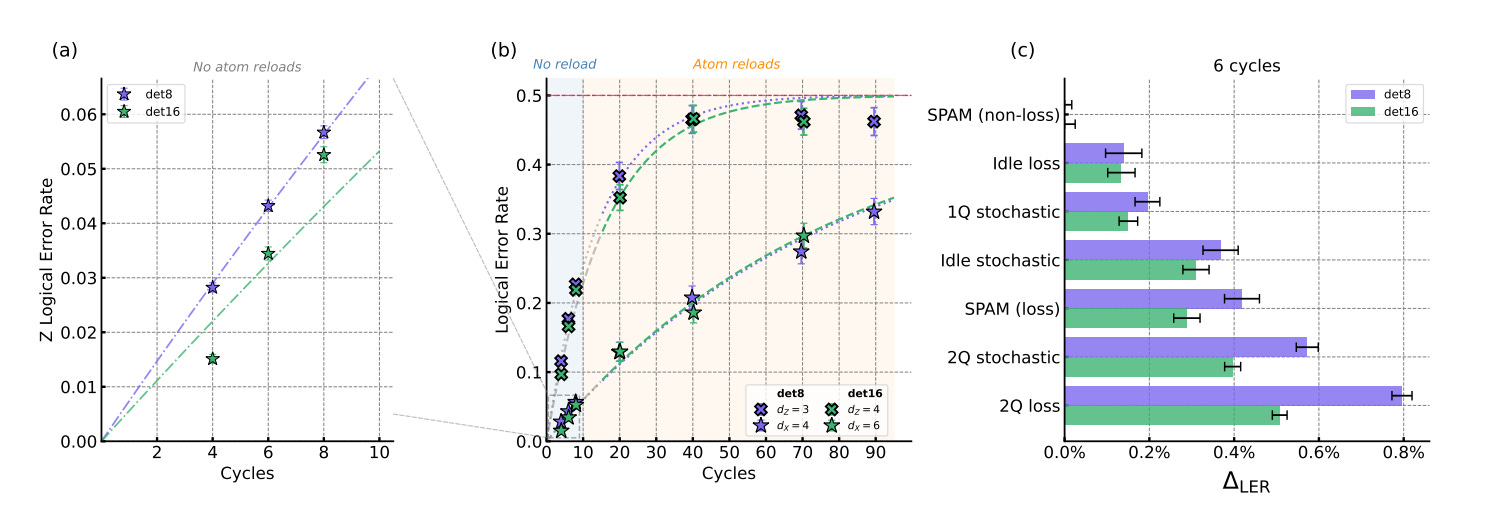
One of the most important charts in the paper. Historically, larger quantum systems often became less reliable as complexity increased. Atom demonstrated the opposite: larger, more redundant systems achieved lower logical error rates.
3. Continuous Mid-Circuit Reloading and Qubit Replenishment
This may be the most important architectural breakthrough in the paper.
Neutral atom systems face a uniquely difficult challenge:
atoms heat during operation
atoms are lost during measurement
atoms physically disappear from the computational array
Instead of treating this as a fatal limitation, Atom designed the architecture around continuous replenishment.
The system continuously:
detects missing or degraded qubits
replaces them
reloads fresh atoms from an external reservoir
preserves logical operation while computation continues
The paper demonstrates that without replenishment, the system eventually degrades and logical operation collapses.
With replenishment, the system stabilizes into steady-state operation over many cycles.
Imagine if servers inside a data center could fail, be physically replaced, and computation could continue uninterrupted without restarting the system.
That is conceptually what Atom demonstrated at the qubit level.
This is one of the clearest demonstrations yet of a quantum architecture beginning to behave like continuously operating computational infrastructure rather than a fragile laboratory experiment.
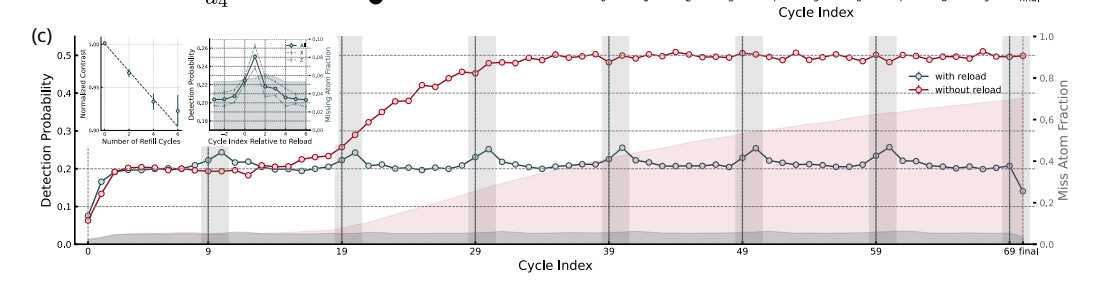
The most important chart in my opinion in the paper. Without atom replenishment, the system degrades and eventually fails. With replenishment, Atom demonstrates steady-state operation. This is one of the first demonstrations of a quantum architecture behaving more like infrastructure than a laboratory experiment.
4. Arbitrary Qubit Connectivity Through Dynamic Atom Movement
Most quantum architectures remain constrained by local connectivity. Qubits can only directly interact with nearby neighbors, creating substantial overhead and coordination complexity as systems scale.
Atom demonstrated an architecture built around dynamic movement of neutral atoms, enabling arbitrary qubit connectivity across the computational system.
A useful analogy is transportation infrastructure.
Most quantum architectures today behave like cities with rigid road systems where information must move block by block through neighboring intersections.
Atom’s architecture behaves more like an air traffic network where qubits can dynamically move and directly interact where needed.
As systems scale, that flexibility matters enormously.
Flexible connectivity can materially improve:
quantum error correction efficiency
logical gate implementation
operational overhead
scalability of larger code families
The paper explicitly highlights that this architecture may enable practical utility-scale codes inaccessible to many nearest-neighbor planar systems.
This is one of the most important long-term advantages of neutral atom architectures and one of the least appreciated by the broader commercial community.
5. Logical Memory That Outlived the Physical Qubits Themselves
Finally, Atom demonstrated logical memories that outlived the underlying physical qubits composing the system.
Physical atom lifetimes were roughly 10–15 seconds.
Logical information persisted:
44 seconds at distance-3
225 seconds at distance-7
That result is conceptually profound.
The computation survived longer than the physical hardware components themselves.
In effect:
the computation survived the death and replacement of the underlying hardware.
That is one of the defining characteristics of true fault-tolerant computing systems.
It means the architecture is beginning to preserve computation independently of the survival of the underlying physical qubits.
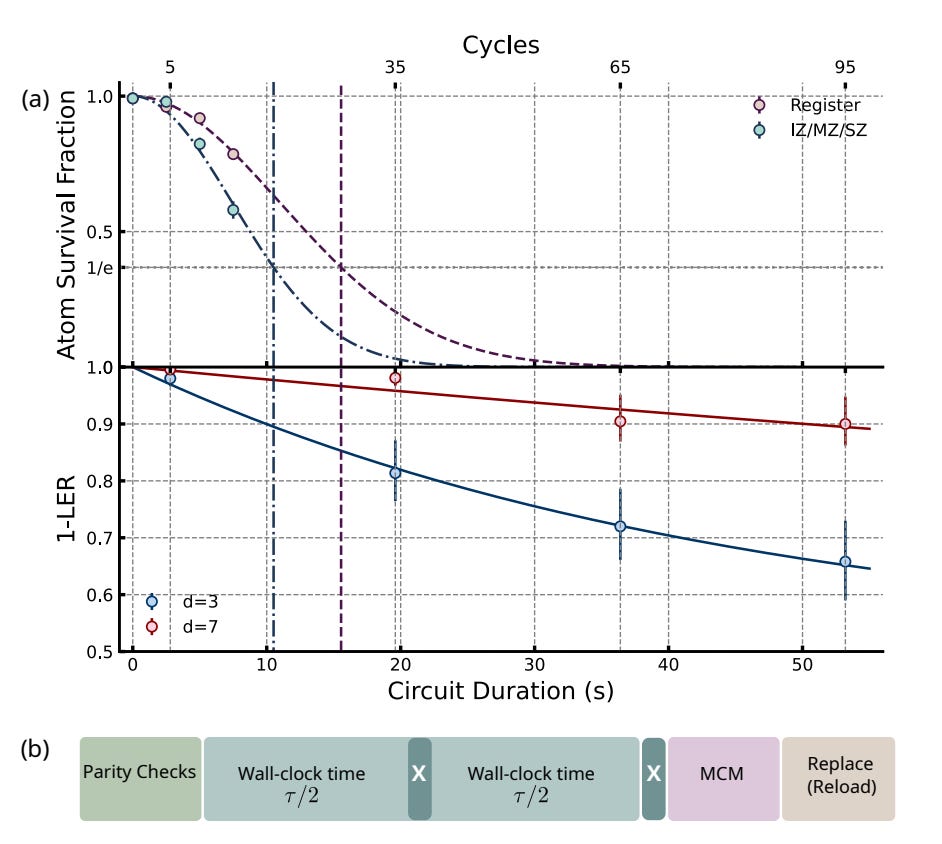
The logical memory survives dramatically longer than the underlying atoms themselves. The computation effectively outlives the hardware components composing it, one of the defining characteristics of fault-tolerant computing.
Why this is such a significant breakthrough
The importance of this paper is not that Atom demonstrated one isolated benchmark.
It is that the company integrated multiple foundational capabilities into a single continuously operating architecture:
repeated error correction
sub-threshold behavior
mid-circuit measurement
qubit replacement
continuous replenishment
arbitrary connectivity
sustained logical memory
Historically, most quantum computing breakthroughs have remained relatively narrow:
improved qubit fidelity
isolated logical operations
shallow memory demonstrations
benchmark circuits
Atom demonstrated something much closer to operational infrastructure.
And importantly, the company did so using a neutral atom architecture that possesses several long-term advantages:
no cryogenic infrastructure
highly scalable qubit counts
flexible connectivity
modularity
dynamic qubit movement
This is the first time a neutral atom architecture has started to resemble operational computing infrastructure rather than an isolated physics demonstration.
The broader takeaway
Utility-scale quantum computing is still ahead of us. Logical error rates remain too high for many commercially important workloads, and substantial scaling challenges remain.
But this paper materially changes the conversation around what architectures may realistically scale.
The frontier in quantum computing is no longer simply:
“Who has the best qubits?”
The frontier is increasingly:
“Who can build continuously operating fault-tolerant computational infrastructure?”
That is a systems engineering problem as much as a physics problem.
And Atom Computing just delivered one of the clearest demonstrations yet that this transition may finally be underway.
They’ve come a long way since we led their Series Seed, and the fun is just starting.